
Function Calculator
A function calculator should do more than plug in numbers. Type f(x) and this one evaluates it, builds a table of values, draws the graph, and marks where it crosses zero, where it turns and where it isn’t defined — with an optional g(x) for comparisons and compositions. Everything is calculated in your browser.
- Free to use
- No sign-up
- Runs in your browser
Function calculator
Use ^ for powers, * or a space-free product like 3x, and functions sin cos tan asin acos atan exp ln (log also means ln) sqrt abs; constants pi and e. Write x*sin(x), not xsin(x).
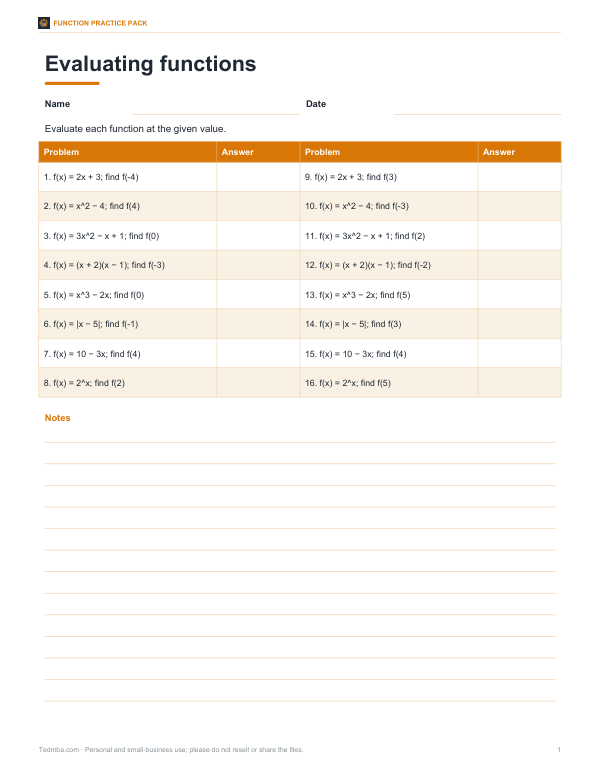
Function Practice Pack
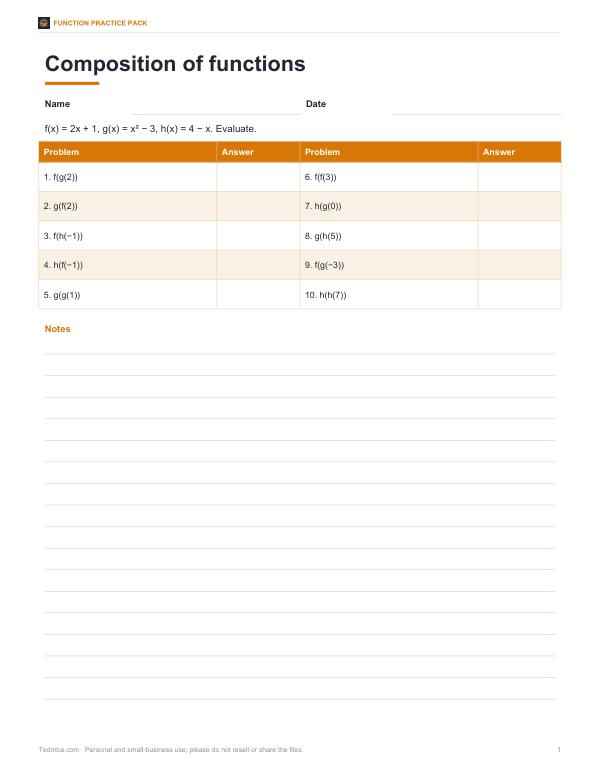
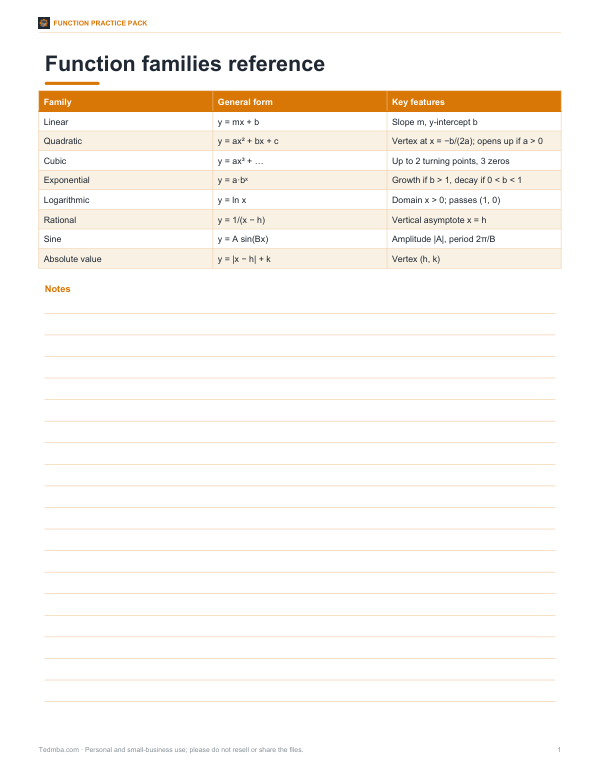
Printable function worksheets with answer keys (evaluation, tables of values, composition, transformations), a function families reference card and coordinate graph paper.
- Evaluation worksheet (PDF/DOCX)
- Composition worksheet (PDF/DOCX)
- Families card (PDF)
- Graph paper (PDF)
Formats: PDF, DOCX. Instant download after payment (link valid 72 hours, up to 5 downloads). AI-assisted: the templates were drafted with AI help and reviewed and laid out before publishing.
$5.00 USD, one-time 4 files · about $1.25 each
- Instant download
- 7-day refund
- Secure checkout by Stripe
7-day money-back guarantee. Full refund within 7 days of purchase, even after you download.
Free sample: Composition Worksheet (PDF, 98 KB)
Full refund within 7 days — see the refund policy and license.
Free printables
Single sheets you can print right now, no sign-up. The full pack adds every sheet in one download plus the editable files.
 Printable Coordinate Graph Paper
What the calculator finds
| Result | How it is found |
|---|---|
| Values f(a) | Direct evaluation at each x you list |
| Table of values | Evaluation at every step across the range |
| Zeros | Sign changes of f across 800 sub-intervals, refined by bisection |
| Turning points | Sign changes of the exact derivative f′(x), refined by bisection |
| Gaps and jumps | Points where f is undefined or changes sign without passing through zero (as at a vertical asymptote) |
| Derivative | Symbolic differentiation with simplification |
| Compositions | f(g(a)) and g(f(a)) evaluated directly |
Zeros and turning points are searched only in the x-range you set, and features narrower than the sampling step can be missed — zoom in on a smaller range if you suspect one.
Worked example: f(x) = x³ − 3x + 1
On the range −3 to 3, the calculator finds three zeros, at x ≈ −1.879, 0.347, 1.532, a local maximum at (−1, 3) and a local minimum at (1, −1). The y-intercept is f(0) = 1 and the derivative is 3x² − 3, which is zero exactly at x = ±1 — matching the turning points. With g(x) = 2x − 1, the composition f(g(2)) = f(3) = 19 while g(f(2)) = g(3) = 5, a reminder that composition order matters.
Domain and range
The domain is the set of x-values where the function is defined. Common restrictions: division by zero (1/x is undefined at 0), square roots of negative numbers (sqrt(x) needs x ≥ 0) and logarithms of non-positive numbers (ln(x) needs x > 0). The range is the set of output values. The graph shows both at a glance: gaps in the curve mark domain restrictions, and the vertical extent shows the range over your chosen interval.
Common function families
| Family | Example | Shape |
|---|---|---|
| Linear | 2x − 1 | Straight line; slope 2, intercept −1 |
| Quadratic | x^2 − 4x + 3 | Parabola; zeros at 1 and 3, vertex at (2, −1) |
| Cubic | x^3 − 3x + 1 | S-shaped; up to two turning points |
| Exponential | 2^x or exp(x) | Rapid growth, always positive |
| Logarithmic | ln(x) | Slow growth, defined for x > 0 |
| Rational | 1/(x − 2) | Vertical asymptote at x = 2 |
| Trigonometric | sin(x) | Periodic wave, period 2π |
| Absolute value | abs(x − 1) | V shape with corner at x = 1 |
Transformations
- f(x) + k shifts the graph up by k; f(x) − k shifts it down.
- f(x − h) shifts it right by h; f(x + h) left by h.
- −f(x) reflects it in the x-axis; f(−x) reflects it in the y-axis.
- a·f(x) stretches it vertically by a factor a.
- f(b·x) compresses it horizontally by a factor b.
Put the original function in f and the transformed one in g to see both on the same axes.
Composition of functions
The composition f(g(x)) means “apply g first, then f”. In general f(g(x)) and g(f(x)) are different. The domain of f(g(x)) is limited both by g’s domain and by whether g’s outputs are in f’s domain: for f(x) = sqrt(x) and g(x) = x − 5, f(g(x)) = sqrt(x − 5) is only defined for x ≥ 5.
Even, odd and periodic functions
A function is even if f(−x) = f(x) for every x — its graph is symmetric about the y-axis, like x² or cos(x). It is odd if f(−x) = −f(x) — symmetric about the origin, like x³ or sin(x). Most functions are neither. To test, put your function in f and the same function with −x in place of x in g: if the curves coincide, f is even; if g is the mirror image of f in the x-axis, f is odd. A periodic function repeats at regular intervals: sin(x) and cos(x) repeat every 2π, tan(x) every π.
Checking answers from a textbook
- Evaluate at the exact value the question uses, including fractions like 1/3 or expressions like pi/4.
- If your answer and the calculator disagree slightly, check rounding — the calculator shows up to six decimal places.
- For zeros, confirm by evaluating f at the reported x; the result should be very close to 0.
- For a turning point, check that f′(x) = 0 there and look at the graph to see whether it is a maximum or minimum.
- Remember that trigonometric functions use radians here: sin(pi/2) = 1.
Tips for typing functions
- Powers: x^2, (x + 1)^3, 2^x.
- Multiply with * or by juxtaposition: 3x, 2(x + 1).
- Put functions in brackets: sin(2x), sqrt(x^2 + 1).
- Use x*sin(x), not xsin(x).
- Roots of negative numbers: x^(1/3) is undefined for negative x here; use −abs(x)^(1/3) on that side if needed.
Privacy
All calculations run in your browser.
Frequently asked questions
How do I find the zeros of a function?
Type f(x) and a range; the calculator finds sign changes and refines them.
Can it graph two functions?
Yes — enter g(x) to draw it on the same axes.
Does it show the derivative?
Yes, as a simplified formula.
Why is part of my graph missing?
The function is undefined there (e.g. square root of a negative number).
What does f(g(x)) mean?
Apply g first, then f to the result.
Is log base 10?
No — log and ln both mean the natural logarithm here; for base 10 use ln(x)/ln(10).
Does it use degrees or radians?
Radians. Convert degrees by multiplying by pi/180.